

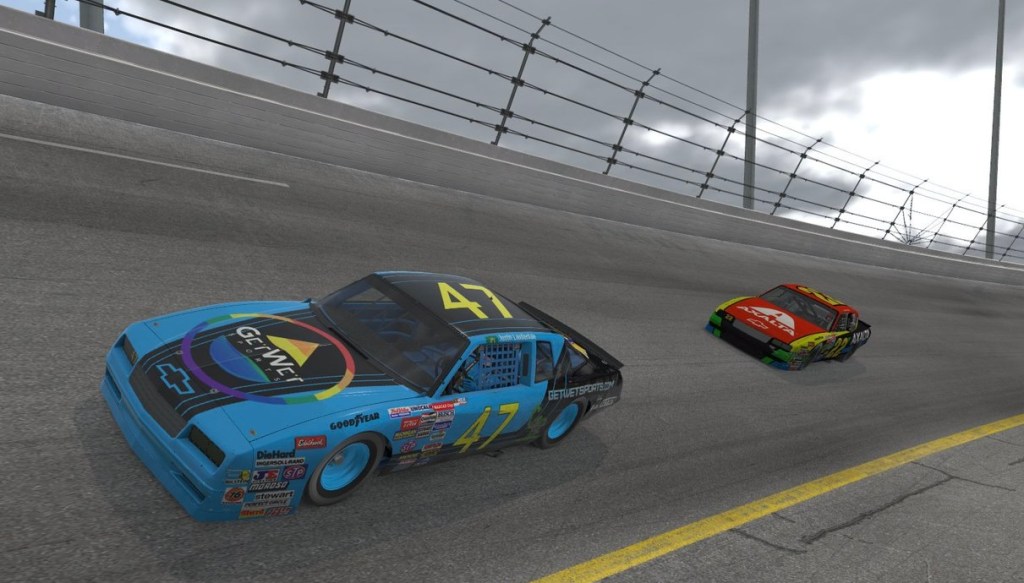
Getting in the Groove
Getting your first win in any type of racing (including sim racing) does weird things to you. Yes, I was excited about finally getting a win, but I wanted more than just the one win.
After my first win, I ran more races the next day. While I didn’t have the same luck for another win, I did notice that my racing as a whole had improved. I spent a while getting top-10 and top-5 finishes. Sure, there were the occasional DNFs due to ARCA shenanigans (anyone who has run on iRacing knows what I’m talking about).
Eventually, I also started driving a few different cars that were available for me to race. The main two I loved driving were the Late Models and Modifieds. I had really taken a liking to short track racing. There was something about the constant focus required for braking, accelerating, and navigating traffic. Little did I know at that time, but running laps in the Modifieds would prove to be excellent practice for something larger in the future.
Firecracker 400 Awaits
During a slower day at work, I was scrolling through Twitter. I used my Twitter account to promote racing streams, showcase paint jobs, and read about the goings-on in both motorsports and sim racing. That’s when I saw an advertisement — the iRacing Firecracker 400, put on by a group known as eracr.gg.
I was curious about the event, so I clicked to read about what was going on. The format was simple: qualify through preliminary races, get a good qualifying time, and race with 40 others in one 400-mile event. How hard could it be?
The race was going to be on Daytona Superspeedway, which was a track I had run a few times by now. The biggest struggle at Daytona in the cars I had run was the traffic more than the turns. By yourself, you can run Daytona at full throttle the entire time with no issues.
I also let GetWetSports — a streamer library and sports news site — know about the event. During this time, I was running a paint scheme with their logo on it because I liked the people behind the website. After I let them know, I discovered a small payment made to my PayPal from them. The message read: “Good luck in the race! From your sponsor.”
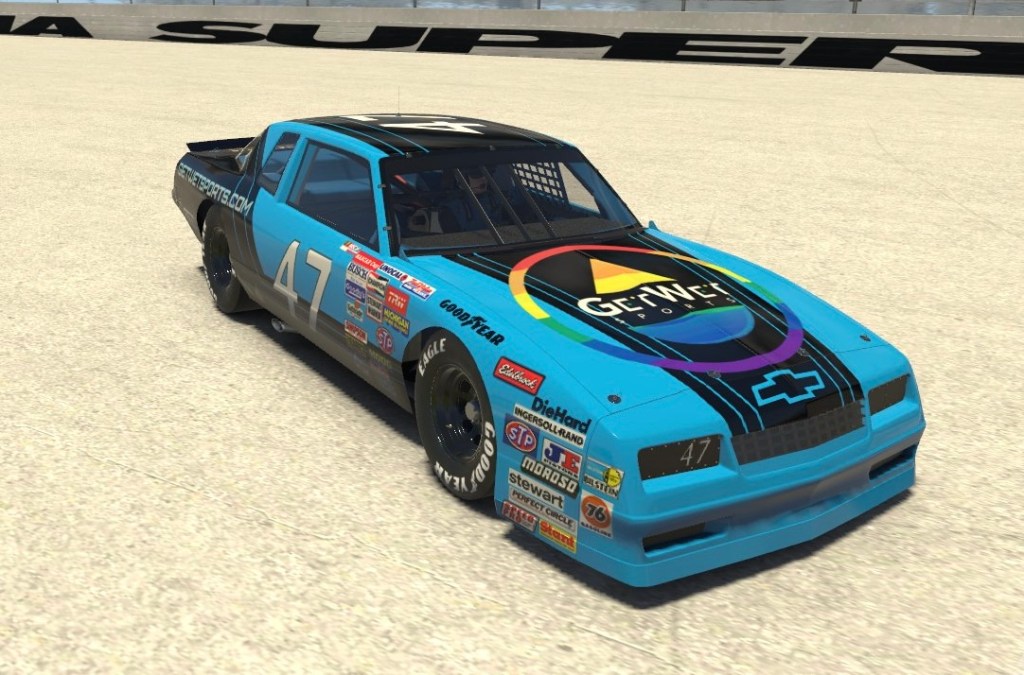
I had just gotten my first sponsor for sim racing.
So now I was signed up, understood the event, and even landed an official sponsorship for the race. I just needed to get some time on track and prepare. Before that happened, I received an email from the event organizers with the entry list and divisions for the preliminary rounds. I found my name in the very last group of drivers.
Among the list that had my name was none other than Dale Earnhardt Jr. Yes, that Dale Earnhardt Jr. — driver of the DEI #8 and Hendrick Motorsports #88, owner of JR Motorsports, NASCAR Hall of Fame member Dale Earnhardt Jr. That immediately raised the intensity of this race. I wasn’t just driving against sim racers; I was also racing against a legendary NASCAR driver. That was the moment I realized I couldn’t just jump in and race this — I would need to put in some work on track.
Taming the ’87s
After reading the entry list, I jumped into a solo test session to run the 1987 NASCAR Monte Carlo on Daytona. I had planned for this to just be a quick session, as Daytona is usually an easy track to run solo.
I got onto the track for the first session and realized that I couldn’t get the car to shift into second. I was used to being able to shift without the clutch, but the ’87s don’t really like to shift in and out of gear without it. So, I had to adjust my driving and actually use the third pedal.
The first two laps went exactly as I expected. The car was glued to the line I wanted to run, and I felt like I was pretty fast. But something happened when I entered the first turn on lap three. The car suddenly got super tight (for my non-racing fans, that basically means the car won’t turn). I slammed into the outside wall and spun out.
I figured I had just screwed something up with the setup, so I reworked how I had the car set up and started again. Same thing — three laps in and into the wall. I tried loosening the setup some more. Again, I was into the wall within three laps. Eventually I had it where I wouldn’t wreck within three laps, but the car was so loose that I couldn’t keep it on the track (loose just means the car is turning too much, which is harder to control and wants to spin).
This was the point where I had to put a lot more work into driving. What started as a quick session to see how the car would perform turned into two weeks of constant driving, where I would spend two to three hours running the Chevy around Daytona over and over, chasing the perfect setup.
I was spending so much time test driving that I found myself running in fewer and fewer races. I wanted to do well in this event so much that it became my primary focus on iRacing.
Luck was on my side, as iRacing had the ’87s racing at Daytona that week. That’s when I realized my problem — thanks to, unfortunately, an angry driver that I had slammed into the wall four laps into the race.
“This isn’t modern NASCAR! You have to lift in the damn corners sometimes!”
The answer was right in my face. On any other track, getting tight in the corner is a sign that you need to lose more speed to make the turn. I hadn’t thought about it because, to me, Daytona was always a track where you held the throttle wide open. I would have never thought about lifting in the corner, even though it was obvious looking back on it.
The ’87 stock cars are not as aerodynamic as the current cars. Not only that, but the tires were completely different. These two factors meant that the cars didn’t glue to the track in the corners — they required you to drive differently.
After figuring that out, I reset my setup to how I liked it and started lifting in the corners once I felt the car getting too tight. Now I was running 15–25 laps easily with no problems. I’d usually jump out because I had been running a large number of laps solo rather than because I had wrecked. I finally felt ready for the race. The night before, I checked a few more settings, logged off my computer, and got a good night’s sleep.
Firecracker Showdown
The day of the event, I was definitely feeling the nerves. Sure, I had been racing on stream for a while now, but this was the first time I was going to be in a large-scale event. The streams themselves were averaging around 3,000 viewers (which is a pretty large audience for a private sim racing event) — a lot more than my usual three viewers.
I started getting things set up when I noticed a Discord call coming in. My friend, Dougie, called me to say good luck and let me know he was in a group call with a few others to watch the race. I thanked him, talked for a minute about how I was feeling, and jumped off the call. The event was starting, and I needed to be ready for my prelim race in about 20 minutes.
I started up my stream, said hello to everyone, and logged onto iRacing. It took a few minutes to get everything set up and loaded. That meant I was sitting there with nothing but my nerves and thoughts.
Eventually, my headphones filled with the sounds of engines running high revs through the corners from cars in the practice session. Unfortunately, I got in the server late, so I had no time to practice. By the time I was in, we were already lining up for our prelim races.
I lined up and noticed there were two cars between me and Dale Jr. Now, I want to emphasize that I didn’t have any lofty dreams about racing against Dale. I didn’t expect that if I beat him, I’d suddenly have a Late Model ride courtesy of JR Motorsports. No — I just would have loved to beat him for the sake of being able to tell my friends and family, “Hey! I beat Dale Earnhardt Jr. in a race!”
We took our pace lap and received the green flag for a quick 10-lap shootout. I mashed the throttle while in second gear and hit my rev marks perfectly. Then I completely missed my shift and put the car back into first gear.
Before I could react, I was hit from behind and sent into the infield. My engine also blew up from the sudden rise in revs. Within two seconds of the race beginning, I was already out of the preliminaries and needed to make my way through the last-chance qualifier.
The LCQ: One Final Chance
After the wreck, I had a minute to just think about what had happened. I was embarrassed. I made a rookie mistake in one of the biggest events I had ever been in. Did I make a mistake entering this event? Should I even be racing here?
I shook the self-doubt out of my head and watched the race continue from the sidelines. Dale had won the preliminary race, and now I had to wait for the other three races to finish. I deserved to be here. I could run well. I just had to shake the nerves and do better in the last-chance qualifier.
After a while of sitting and waiting, the last-chance qualifier was beginning. To get through, I needed to finish tenth or better. I had 20 laps to go from 20th (my current position) and make up 10 spots to make it to the final race of the preliminaries.
The green flag waved, and thankfully I didn’t mess up my shifting. All the practice seemed to pay off — I was able to keep up and run with everyone around me. Slowly but surely, I started making up spots. In about five laps, I had risen to 16th.
We entered Turn 1 on lap six when I suddenly sensed a problem. I slightly backed off my pace — turns out, my gut was right. Two cars in front of me hit each other in the wrong spot during the corner. I watched both suddenly shoot up the track and take out another two cars that were running above me.
I dove down low to avoid spinning cars and debris. A car appeared in the right side of my screen — another car coming down the track sideways. Against my instincts, I turned toward where his car was. Luckily, it was the right decision. From my time running the ARCA cars, I knew the car sideways in front of me was going to come back down the track. That’s exactly what happened, and I made it through the wreck unscathed.
During the caution laps, I saw that I was now sitting in 12th place — only two positions away from transferring. The green flag finally came back out with nine laps to go. I stuck right behind the car in front of me until I saw an opening to get back to the bottom of the track. I took it immediately, because I’d had multiple issues running the top line during practices.
I got right on the guy’s rear bumper and began drafting. My plan was simple: follow the guy in front of me and either move up with him or slingshot in front of him at the line. I saw that I was now sitting in 11th position — just one spot shy of transferring.
The next eight laps were uneventful. We weren’t moving backward, but we couldn’t move up either. The white flag waved, and I was still in 11th. I was so close to transferring that I could taste it.
We entered the backstretch and started losing the two in front of us. They’d caught up with the 7th-place driver and were pulling away. It was settled — to make it through, I was going to have to fly past the driver I was working with.
We entered Turn 3, and I realized my tires were worn pretty badly. While my draft partner could stick to the bottom, I was sliding around and struggling to keep grip. We exited Turn 4, and I was still right behind. I had to make my move now. I dove underneath the guy in front of me as we sped toward the line.
I didn’t have enough of a run made, and I finished 11th.
Post-Firecracker: Lessons Learned, Decisions Made
I sat in the lobby for a minute just staring at the screen. I didn’t actually think I’d get that close to competing in the main event, but I had almost done it. Still, I definitely felt a little down after the race. Getting that close and missing by such a small margin stung.
That’s when I got another Discord call.
Dougie was extremely excited when I answered. He was never really into racing but was telling me how intense and exciting the race was. Apparently, he and a few other streaming friends had been watching the official broadcast. They mentioned I was featured pretty heavily in the closing laps because I was in the final transfer position.
I even received a message from GetWetSports congratulating me on a good race. While I didn’t make it through, they said I had represented them well and that they were going to start paying more attention to sim racing.
For myself, I realized that I really loved running these types of events. I decided then that I wanted to run in a private league, as I enjoyed the structure and competition of those races. That decision would lead me into one of the most intense series of races I’d ever run on iRacing — a battle for a championship.
 JTL Writes
Leave a comment